Gait Initiation

Whole Brain Connectomics for Embodied Learning

FlyLearn investigates how whole-brain connectomics can guide embodied learning. Starting from the fruit fly’s neural wiring, we study how connectivity shapes information processing and the coordination of perception and action. Our goal is to turn biological connectivity into useful architectural principles for artificial learning systems, while developing computational models that help us understand brain–body interactions.
Our work spans connectome-based movement control, efficient information routing, and neural control across different bodies. We build controllers from whole-brain wiring diagrams, draw on their organization to design learning algorithms, and connect neural models to simulated and physical agents through learnable sensory and motor interfaces. Together, these directions explore how neural structure and embodiment can support efficient learning and flexible behavior.
FlyGM instantiates the adult Drosophila whole-brain connectome as a graph-based controller for a simulated biomechanical fly. Trained through imitation learning and reinforcement learning, it supports walking, turning, and flight, with improved learning efficiency and angular tracking accuracy over alternative architectures. Its internal representations provide a way to study sensorimotor information flow.
Scroll horizontally to explore the locomotion demonstrations →


Whole-Brain Connectomic Graph Model Enables Whole-Body Locomotion Control in Fruit Fly →
Inspired by long-range connections in the fly connectome, Stochastic Attention randomly permutes tokens around windowed attention to enable communication beyond local neighborhoods. Combined with sliding-window attention, it balances local structure and global information flow at linear per-layer cost for a fixed window size. Experiments demonstrate benefits in language-model pre-training and training-free inference.
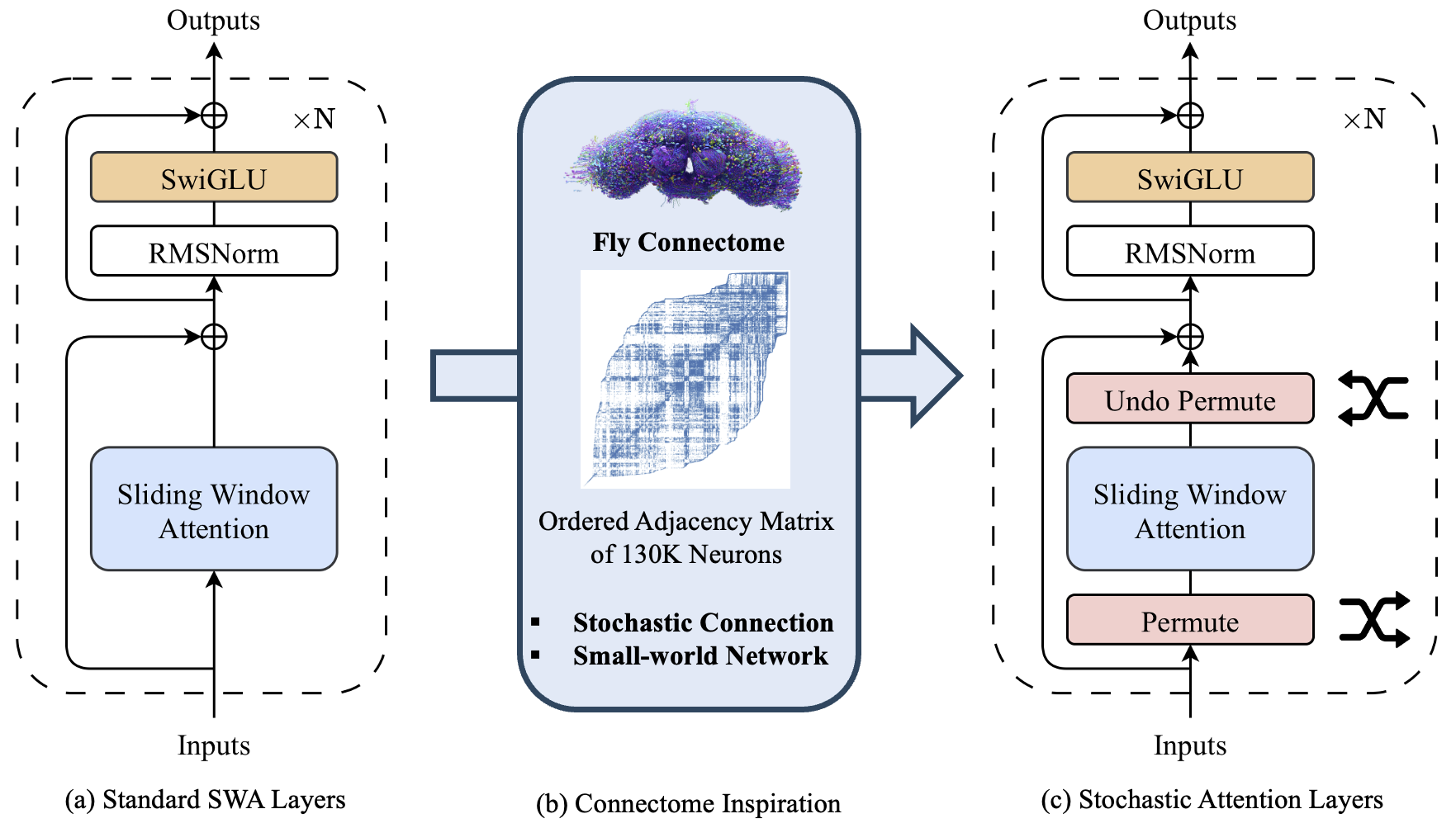
Stochastic Attention: Randomized Routing for Expressive Linear-Time Attention →
We connect a Drosophila whole-brain connectomic model to an aerial-terrestrial drone through learnable sensory and motor interfaces. The resulting controller supports ground locomotion and flight, providing a platform to investigate how connectome-based architectures coordinate movement across different bodies and motion modes.
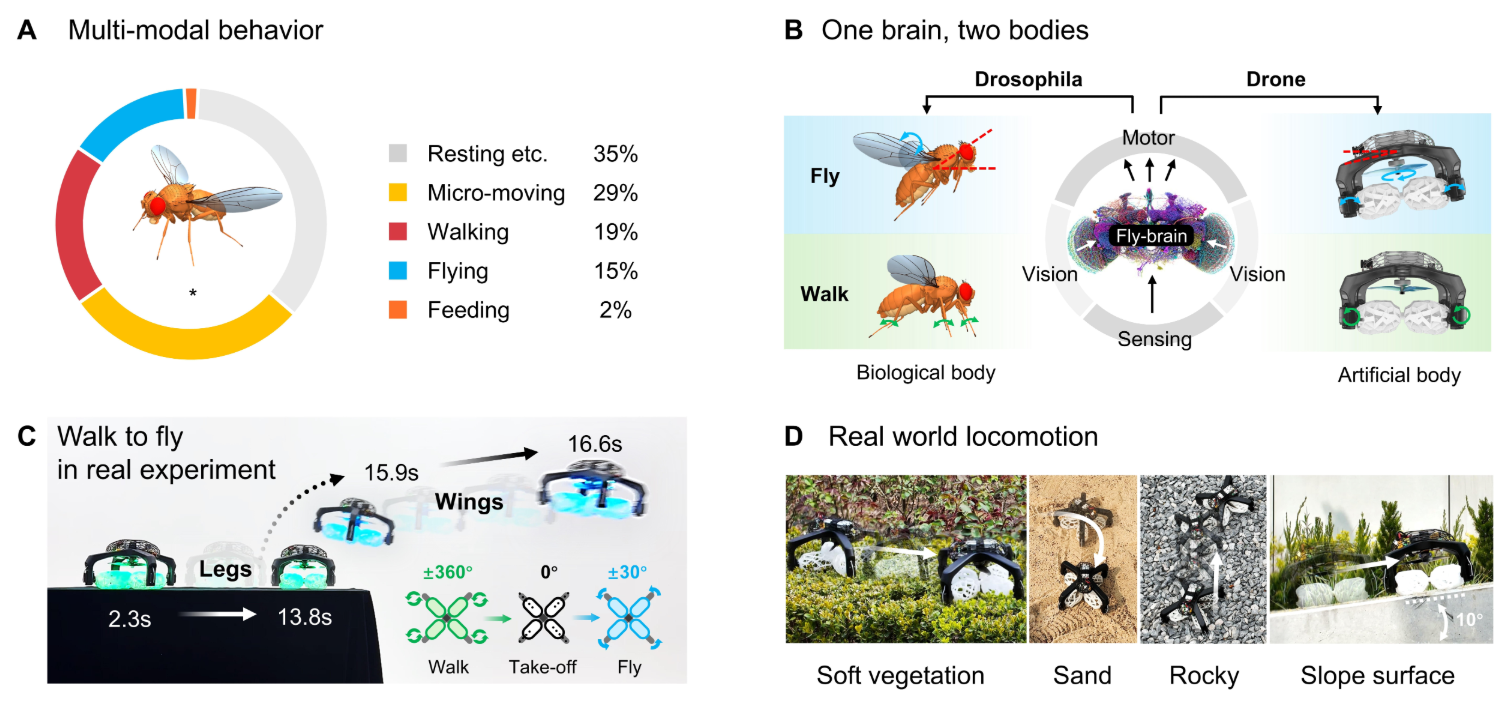
We study which parts of the Drosophila connectome support walking by learning L1-regularized node importance in a trained FlyGM controller. Pruning by importance identifies a compact subnetwork. This offers a way to relate connectome structure to motor function.

arXiv:2602.17997 · 2026
FlyGM turns whole-brain connectivity into an architectural prior for a simulated fly controller. Combining imitation learning with reinforcement-learning fine-tuning, it supports terrestrial locomotion and flight. The study evaluates learning efficiency, tracking performance, and internal representations against alternative network architectures.
arXiv:2604.00754 · 2026
SA uses randomized token routing to extend windowed attention beyond local neighborhoods at O(nw) cost per layer. Experiments on language-model pre-training and training-free inference demonstrate its complementarity with local attention and its effectiveness as an efficient attention mechanism.